






“PPWR is a series of hard deadlines that turn packaging from a disposable byproduct into a regulated digital asset.”
The European Union is redefining the packaging industry. The Packaging and Packaging Waste Regulation (PPWR) has moved past the negotiation phase and into the implementation horizon. For any company manufacturing, using, or distributing packaging in the EU market, the transition from “voluntary sustainability” to “mandatory compliance” has officially begun.
What is PPWR?
The Packaging and Packaging Waste Regulation (PPWR) is European legislation that harmonizes the fragmented packaging laws across the EU. Unlike a ‘Directive’ which allows for varying national interpretations, this Regulation is a binding legal act that applies directly and uniformly to all 27 Member States. Its main objective is to decouple economic growth from packaging waste generation.
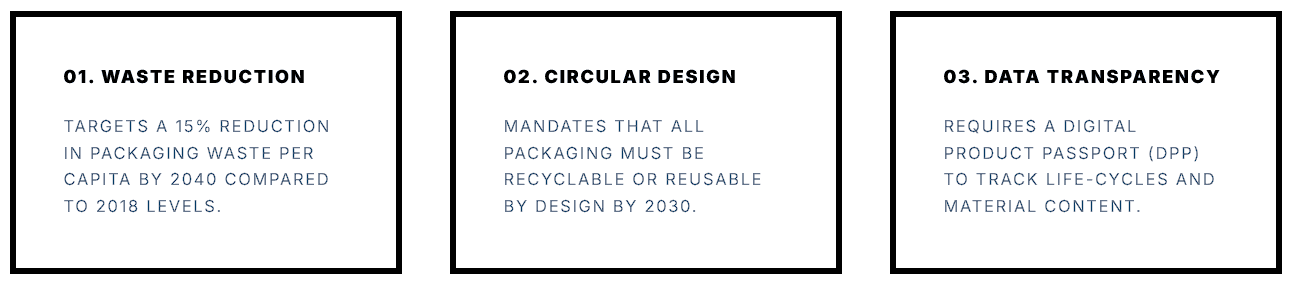
How it affects the industry
The PPWR restructures how the packaging industry operates. For packaging manufacturers and brands, it brings these operational shifts:
- Mandated Minimization: Packaging must be reduced to the absolute minimum necessary weight and volume to ensure functionality. Over-packaging is now a legal liability punishable by heavy fines.
- Restriction of Formats: Many single-use plastic formats, such as those used for fresh produce or hospitality condiments, will be banned entirely, forcing a move to alternative materials or reusable systems.
- Recycled Content Minimums: Any plastic packaging placed on the market must contain a specific percentage of post-consumer recycled waste, which changes how packaging is procured.
- Reuse at Scale: Large-scale reuse becomes mandatory for transport and e-commerce logistics. Companies must hit hard volume targets or face market exclusion.
The PPWR shifts the industry’s focus from disposable volume to asset performance. This is where the gap between current logistics and regulatory requirements is widest.
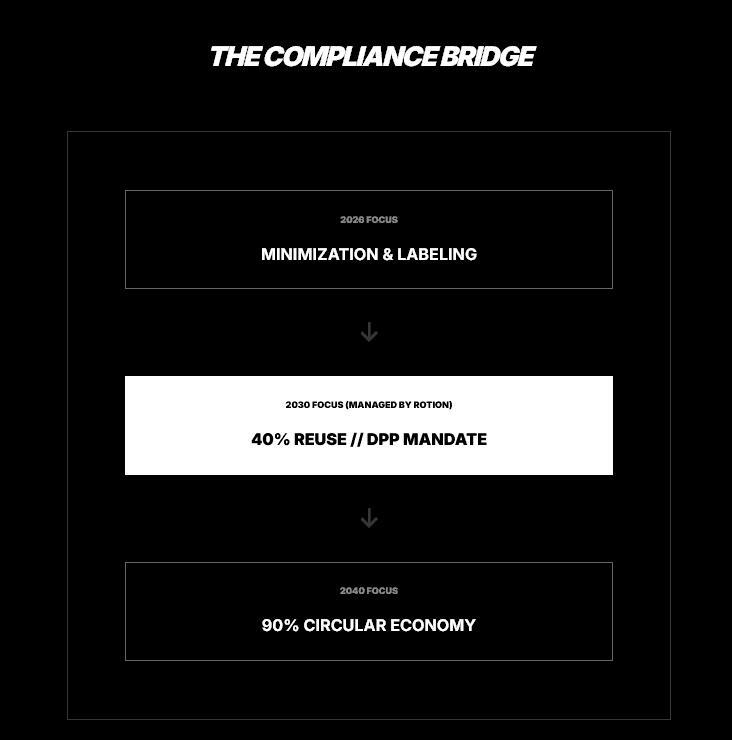
The compliance roadmap: 2026 to 2040
To navigate the PPWR, companies must understand the timeline. It rolls out in tiers, and the operational pressure rises at each step.
August 2026: the application deadline
This is 18 months after the regulation’s entry into force. Most provisions of the PPWR become legally applicable.
- Mandatory Packaging Minimization
- Recyclability Design Criteria Phase 1
- Substance Restrictions (PFAS bans in food contact)
- Labeling Requirements & Unified Sorting Instructions
2027: the data protocols
The European Commission will finalize the Delegated Acts regarding the methodology for reporting. This is the year where the “Digital Product Passport” (DPP) technical standards are finalized.
How Rotion Bridges the Gap: Rotion is already built on GS1 standards, so when the 2027 data protocols land, your data already follows the standard they build on.
2030: the scale jump

2040: the circular horizon
By 2040, the industry must achieve 90% reuse in transport packaging and 50% in e-commerce. At this volume, manual tracking stops working. Full digital tracking with Rotion becomes a baseline requirement.
The data mandate: why DPP is mandatory
Under PPWR, you cannot claim what you cannot prove. The introduction of the Digital Product Passport (DPP) means that every piece of reusable packaging must carry a digital thread. Regulators require granular data on:
- Lifecycle Verification: Verified logs of every trip taken by the asset.
- Material Integrity: Accurate records of recycled content and recyclability performance.
- Turn Performance: Proof that the reuse targets are being met across the entire fleet, not just in isolated pilots.
Without a system like Rotion, the administrative burden of DPP compliance will consume the financial margins of the circular model. Rotion bridges this gap by automating the data capture at every node of the supply chain.
How Rotion bridges the gap
Rotion was built for this regulation. We provide the system of record that turns compliance into a competitive edge.
-
Automated audit trails for 2026
Rotion’s Digital Twins automatically log every turn, wash, and repair. When the August 2026 deadline arrives, your data is already being recorded, so you export your performance figures instead of estimating them.
-
SSCC batching for the 2030 jump
To hit a 40% transport reuse target in 2030, you need high-volume scanning. Rotion’s SSCC batching lets you scan one pallet and update 100 crates at once, so scanning does not slow down a compliant circular system.
-
AI governance for the 2040 horizon
When 90% of your fleet is circular, loss prevention is a survival metric. Rotion’s AI Anomaly Detection identifies leakage in real time, so the high-value assets needed for 2040 compliance stay in the loop.
The compliance bridge
The future belongs to the digitalized loop.
PPWR ends business as usual, and August 2026 is the starting line. The companies that build the digital infrastructure for reuse today will lead the market in 2040.