

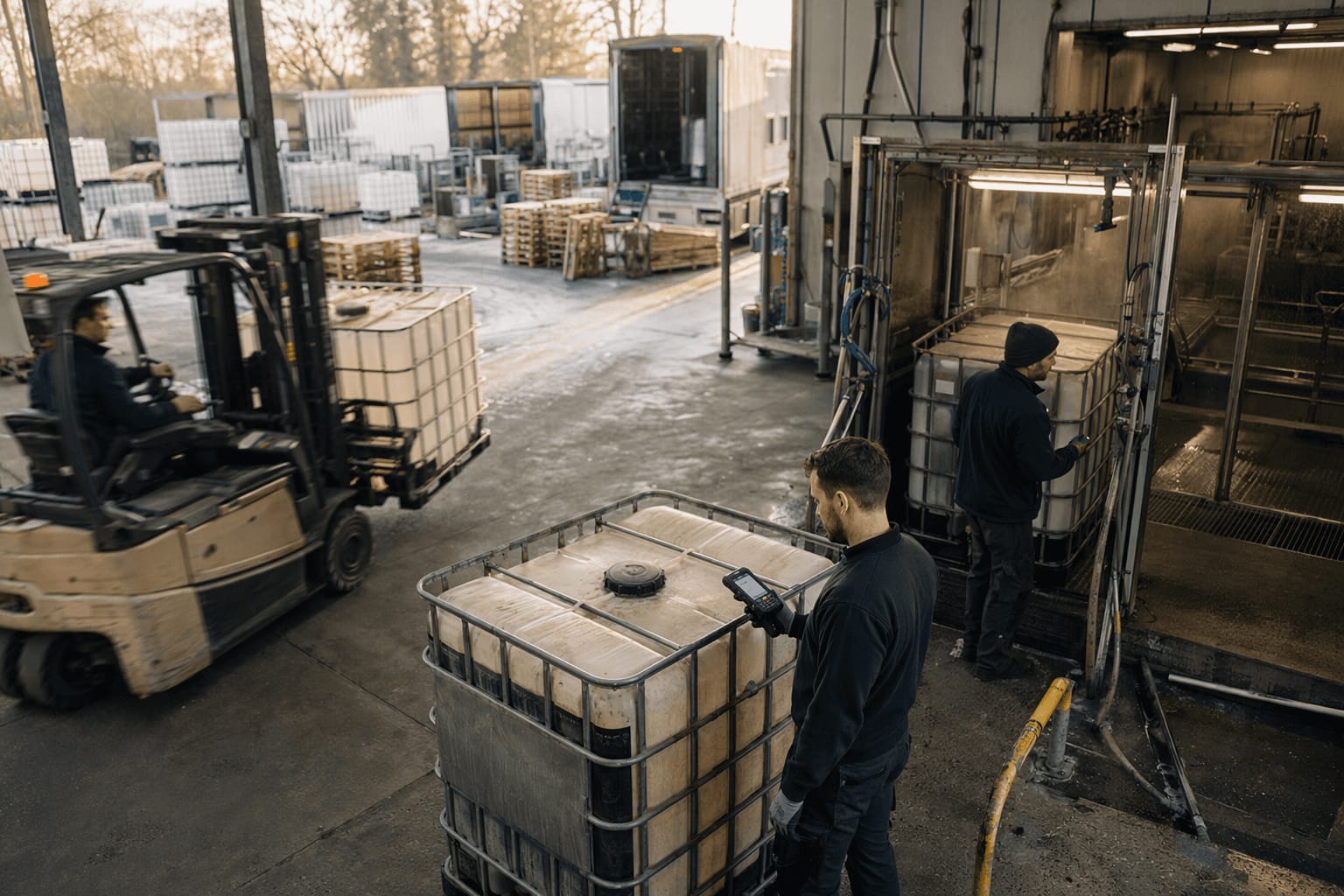
If your IBC tote loop keeps losing units, the root problem is usually ownership at handoff. More scanning rarely fixes it. You need one operating model that assigns accountability for each movement, each delay, and each disputed return across sites, carriers, wash partners, and customers.
IBC loop at a glance: the four controls that cut loss fastest
- Identity control: every IBC tote has one durable ID and one status owner.
- Handoff control: each check-out and check-in event has timestamp, location, and counterparty.
- Exception control: every missing or late IBC tote gets one owner and one SLA.
- Financial control: deposit or liability rules are tied to event evidence, not inbox threads.
Start here before adding more dashboards. Most IBC loss comes from unclear governance, and more visibility alone will not close it.
Why do IBC totes go missing in multi-partner loops?
IBC totes go missing when operational ownership is split while accountability is not. In a multi-partner loop, one team fills, another transports, another stores, and another cleans or returns. If each party has a different source of truth, unresolved exceptions become normal and losses become accepted as overhead.
The typical failure pattern is predictable:
- Dispatch events are recorded, but receipt confirmation is optional.
- Returned totes are counted in batches, not by individual unit.
- Damage, contamination, and quarantine statuses are tracked outside the core flow.
- Liability decisions are made after the fact from partial evidence.
Rotion solves this by treating IBC tracking as an operations control problem. Every tote movement is an event with ownership, and every exception is routed to one accountable party with a due date.
For teams that currently reconcile from spreadsheets, the first win to aim for is stopping open-ended disputes. When each disputed movement has one owner, one evidence trail, and one escalation path, loss rates become manageable.
How does an IBC tote tracking loop work from dispatch to return?
An effective IBC tracking loop has one shared event chain from outbound dispatch to verified return. Each step records who had custody, what changed, and what must happen next. Exceptions then close on evidence, and Rotion can enforce circulation rules across counterparties.
Use a five-step loop:
- Prepare and assign: create or confirm the IBC unit record, customer assignment, route, and expected return window.
- Dispatch with custody proof: capture check-out event with operator, location, timestamp, and linked shipment reference.
- Confirm receipt and state: capture arrival, condition, and fill or empty status at the receiving site.
- Return or transfer: record handback, wash transfer, or onward movement with counterparty acceptance.
- Close exceptions daily: route overdue, missing, and condition-mismatch cases to named owners until closure.
Do not skip step five. Most IBC loss programs fail because exceptions are reviewed monthly. By then, evidence quality has already dropped and nobody agrees on timing.
What should IBC tracking software do before you scale?
Before you scale IBC tracking software, verify that it enforces operating behavior as well as reporting on it. The platform should prevent custody ambiguity at handoff, tie financial consequences to event evidence, and keep one history per unit across all partners. Otherwise, scale only multiplies dispute volume.
Use this pre-scale checklist:
- Unit-level identity: every IBC tote has one persistent ID and lifecycle state.
- Role-based workflows: filler, carrier, customer, wash site, and admin each see required actions.
- Exception SLA engine: overdue or mismatch events auto-create tasks with owner and deadline.
- Evidence attachments: photos, notes, and documents are linked to the exact movement.
- Liability logic: deposit or replacement rules are triggered by agreed event outcomes.
- Cross-site visibility: one ledger across plants, depots, and customer locations.
- Exportable compliance data: event history can be exported for audits and producer reporting.
If your current stack cannot pass that checklist, do not add more scanning hardware first. Fix process control first, then optimize capture speed.
How do EU and US compliance rules change IBC tracking requirements?
EU and US regulations are different, but both increase the cost of weak packaging data. The safest approach is one event model that supports both regions. Rotion keeps the operating flow the same while exposing region-specific reporting views for legal and producer-responsibility requirements.
For EU teams:
- The Packaging and Packaging Waste Regulation entered into force in February 2025 and applies from 12 August 2026, with phased obligations. Source: https://environment.ec.europa.eu/news/new-eu-rules-packaging-enter-application-2026-08-11_en (retrieved 2026-09-07).
- The regulation sets sustainability and labeling requirements across the packaging life cycle and pushes reuse, refill, and recycling outcomes. Source: https://eur-lex.europa.eu/EN/legal-content/summary/packaging-and-packaging-waste-from-2026.html (retrieved 2026-09-07).
For US teams:
- Washington’s Recycling Reform Act requires covered producers to join and fund a PRO, with obligations starting in 2026 and system reimbursement from 2030. Source: https://ecology.wa.gov/waste-toxics/reducing-recycling-waste/our-recycling-programs/recycling-reform-act and https://ecology.wa.gov/waste-toxics/reducing-recycling-waste/our-recycling-programs/recycling-reform-act/producer-responsibility-organization (retrieved 2026-09-07).
- Oregon requires covered-product producers to register with a PRO, report supply data, and pay membership fees from 2025 onward. Source: https://www.oregon.gov/deq/recycling/Pages/Producers-of-Covered-Products.aspx (retrieved 2026-09-07).
- Minnesota states that, after 1 January 2032, covered packaging and paper products must be refillable, reusable, recyclable, or compostable. Source: https://www.pca.state.mn.us/air-water-land-climate/extended-producer-responsibility-for-packaging (retrieved 2026-09-07).
- California SB 54 establishes packaging EPR and sets 2032 targets, including recyclable or compostable packaging and plastic reduction and recycling milestones. Source: https://calrecycle.ca.gov/packaging/packaging-epr/ and https://calrecycle.ca.gov/packaging/packaging-epr/producerguidance/ (retrieved 2026-09-07).
For hazardous-material IBC operations in the US:
- 49 CFR 180.352 requires periodic retest and inspection cycles, including 2.5-year leakproofness and visual intervals and 5-year periodic requirements, depending on IBC use and class. Source: https://www.ecfr.gov/current/title-49/subtitle-B/chapter-I/subchapter-C/part-180/subpart-D/section-180.352 (retrieved 2026-09-07).
For oil-handling facilities under SPCC scope:
- 40 CFR 112.7(c) requires containment or diversionary structures to prevent discharges, and EPA guidance ties this directly to container-level secondary containment planning. Source: https://www.epa.gov/oil-spills-prevention-and-preparedness-regulations/secondary-containment-each-container-under-spcc and https://www.ecfr.gov/current/title-40/chapter-I/subchapter-D/part-112/subpart-A/section-112.7 (retrieved 2026-09-07).
IBC tracking cannot stay a local spreadsheet process, because compliance evidence now depends on event quality and closure discipline.
What is a practical 30-day pilot for one IBC lane?
The fastest IBC pilot is one lane, one customer cluster, and one exception board. In 30 days, aim to prove that your team can close exceptions faster, reduce unknown custody, and produce defensible event evidence without extra admin overhead. Enterprise rollout can wait.
Use this sequence:
- Week 1: map current handoffs and define event ownership by role.
- Week 2: onboard one lane, one site owner per party, and one daily exception review.
- Week 3: enforce SLA on overdue and mismatch events, then tune rules.
- Week 4: review closure speed, unknown-custody count, and disputed replacement decisions.
When this lane is stable, repeat the template route by route. That is how Rotion scales reusable packaging operations without importing chaos into every new partner.
If you are running an IBC tote program today, start with the IBC hub page and then run the 30-day pilot playbook above:
- IBC hub page: https://www.rotion.eu/ibc-tracking
- Starter flow for high-intent teams: https://startup.rotion.eu/?asset=ibc&utm_source=blog&utm_campaign=reduce-ibc-tote-losses-multi-partner-loop
FAQ
Which tag type should we use on IBC totes?
Use the tag your operators will actually scan at every handoff. Rotion is hardware-agnostic, so QR, barcode, and RFID can all work. The right choice depends on environment, scan distance, and whether your bottleneck is speed, durability, or process adoption.
Do we need separate systems for EU and US IBC loops?
Usually no. Most teams can run one operating model and add region-specific compliance views. Keep one event ledger, one ownership model, and one exception workflow. Split reporting outputs by jurisdiction only where legal requirements differ.
Can we start if we only track one customer lane today?
Yes. One lane is the right starting scope. What matters is whether your team can close exceptions quickly and consistently with clear ownership, whatever the volume. If that works on one lane, rolling out means repeating the same setup on the next lanes.